
When you’re buying a home in Florida, sellers and real estate agents want to know you’re serious — and that starts with understanding the difference between pre-qualification and pre-approval. Pre-qualification is a quick, informal estimate based on self-reported information. Pre-approval is a verified, documented review of your income, assets, and credit that carries real weight in a competitive Florida market.
The right tools make this process faster, more accurate, and — critically — protect your credit score along the way. Florida Mortgage Maestro’s NoTouch Credit process, for example, uses a soft pull so you can explore your eligibility without a hard inquiry hitting your report. This list covers the top tools and resources — from broker platforms to government calculators to official program pages — that Florida homebuyers should use when navigating pre-qualification and pre-approval in 2026.
Each tool is evaluated for accuracy, Florida relevance, and whether it genuinely moves you closer to a purchase-ready position.
Article by Duane Buziak, NMLS #1110647 | Coast2Coast Mortgage LLC, NMLS #376205 | Florida-licensed mortgage broker serving clients statewide
Pre-Qualification vs. Pre-Approval: What Florida Buyers Actually Need to Know
Before diving into the tools, it helps to see the difference side by side. Many buyers use these terms interchangeably, but sellers and listing agents absolutely do not.
Pre-Qualification is an informal estimate. You provide income, asset, and debt figures verbally or through a form — no documentation required, no credit verification. It takes minutes and gives you a ballpark number. It does not carry weight in a competitive offer situation.
Pre-Approval is a documented, verified assessment. The broker reviews pay stubs, W-2s, bank statements, and pulls credit. It results in a conditional commitment that sellers and agents treat as credible. In Florida’s active market, submitting an offer without a pre-approval letter is often enough to be passed over entirely.
Here is how the two compare across the factors that matter most:
Credit Pull Type: Pre-qualification uses no pull or a soft pull. Pre-approval traditionally uses a hard pull — though Florida Mortgage Maestro’s NoTouch Credit process uses a Vantage Score 4.0 soft pull for the initial assessment, allowing buyers to get genuine pre-approval guidance without a hard inquiry.
Income Verification: Pre-qualification relies on self-reported figures. Pre-approval requires documented proof — pay stubs, W-2s, tax transcripts, or bank statements for self-employed buyers.
Asset Verification: Pre-qualification skips this step. Pre-approval requires bank statements or investment account documentation.
Seller Acceptance: Pre-qualification letters are often dismissed in competitive markets. Pre-approval letters carry genuine weight and are frequently required before a showing.
Time to Obtain: Pre-qualification can be completed in minutes. Pre-approval typically takes 24 to 72 hours, depending on document readiness and the broker’s process.
Best Used When: Pre-qualification is useful for early budgeting and exploration. Pre-approval is required once you are actively making offers.
One Florida-specific note worth flagging early: because Florida has no state income tax, your gross income goes further when a lender calculates your debt-to-income ratio. Income that would be reduced by state tax obligations in most other states is fully available for debt service here — a genuine qualification advantage that many buyers overlook during the pre-approval planning stage.
1. Florida Mortgage Maestro — NoTouch Credit Pre-Approval
Best for: Florida buyers who want genuine pre-approval guidance without a hard credit inquiry
Florida Mortgage Maestro is a Florida-licensed mortgage broker platform that lets buyers get a genuine pre-approval assessment using a Vantage Score 4.0 soft pull — no hard inquiry, no credit score impact — while simultaneously shopping hundreds of lenders to find the best-fit loan program.
Where This Tool Shines
The NoTouch Credit process is the standout feature here. Most pre-approval processes begin with a hard inquiry that immediately affects your credit score — and if you are shopping multiple brokers, each hard pull compounds the impact. Florida Mortgage Maestro’s soft credit pull mortgage approach means you can get a real picture of your eligibility before committing to a formal application. That matters most when you are early in your search or comparing programs.
The lender-shopping model is equally important. Rather than being limited to one institution’s product set, the platform accesses hundreds of lenders simultaneously. For Florida buyers who may qualify for layered programs — VA plus Salute Our Soldiers DPA, or FHA plus FL Assist — having a broker who can match programs across a broad lender pool is a material advantage, not a marketing claim.
Key Features
NoTouch Credit Process: Vantage Score 4.0 soft pull delivers mortgage pre-approval without hard pull impact — your credit score is not affected during the eligibility assessment.
Multi-Lender Shopping: Shops hundreds of lenders at one time, increasing the likelihood of finding the most competitive rate and program fit for your specific profile.
Florida DPA Program Access: FL Assist ($10,000, 0% deferred), FL HLP ($10,000, 3% amortizing over 15 years), and Salute Our Soldiers are all available through participating lender relationships.
Loan Program Breadth: VA, FHA, USDA, Jumbo, Non-QM, DSCR, and Cash-Out Refinances up to 90% LTV — most buyer profiles are covered without referral elsewhere.
Speed and Availability: 24/7 statewide service with some of the fastest close times available in Florida — critical when competing in a multiple-offer situation.
Best For
First-time buyers who want to explore eligibility without credit risk, veterans pursuing VA financing layered with Florida DPA, self-employed buyers needing Non-QM or bank statement loan options, and anyone who wants a Florida-licensed mortgage broker serving clients statewide rather than a call-center lender with no local program knowledge.
Pricing
No fee for consultation or eligibility check. Broker compensation is disclosed at application per RESPA requirements. The no-credit-hit mortgage application process begins at no cost to the buyer.
2. CFPB Mortgage Calculator
Best for: Stress-testing affordability and understanding DTI before approaching a broker
The Consumer Financial Protection Bureau’s mortgage calculator is a no-cost, no-upsell resource for calculating monthly payments, understanding how rate changes affect affordability, and pressure-testing your debt-to-income ratio before you sit down with a broker.
Where This Tool Shines
What separates the CFPB calculator from commercial alternatives is what it does not do: it does not collect your data, sell your information, or redirect you to a lender. The calculation framework mirrors what lenders actually use for payment estimates, which makes it genuinely useful rather than decorative.
For Florida buyers specifically, the tool is most valuable when used alongside an understanding of Florida’s no state income tax advantage. Because Florida residents keep income that would otherwise go to state taxes in other states, the available monthly income for debt service is higher — and running those numbers through the CFPB calculator before your pre-approval conversation gives you a more accurate picture of your real qualification ceiling.
Key Features
All-In Payment View: Calculates principal, interest, taxes, insurance, and PMI in a single view — not just the base mortgage payment that many commercial calculators show.
Rate Scenario Comparison: Allows side-by-side rate comparisons, which is useful before pre-approval conversations when you want to understand how a 0.25% rate difference affects your monthly obligation.
No Data Collection: No account required, no data sold, no upsell — a meaningful distinction from commercial mortgage calculators.
Government-Backed Accuracy: The same calculation methodology lenders use for payment estimates — no marketing inflation in the numbers.
Best For
Buyers in the early research phase who want to understand their affordability range before speaking with a broker. Also useful for comparing the monthly cost impact of different loan amounts or down payment scenarios ahead of a formal pre-approval.
Pricing
Free. No account required. No data collected.
3. Florida Housing Finance Corporation — Program Portal
Best for: Buyers who plan to layer down payment assistance onto their pre-approval
Florida Housing Finance Corporation is the official portal for Florida’s state-backed homebuyer assistance programs — including FL Assist, FL HLP, and Salute Our Soldiers. If you are considering DPA, this is the authoritative source for current program terms.
Where This Tool Shines
Understanding DPA programs before pre-approval changes how you approach the entire process. A buyer who plans to use FL Assist needs a participating lender — not every broker can originate Florida Housing-backed loans. Knowing this before you start shopping saves significant time and prevents the frustration of getting deep into a pre-approval only to find your broker cannot access the program.
The portal also provides the county-level income and purchase price limits that determine eligibility. These limits vary meaningfully across Florida — what qualifies in a rural county may not qualify in Miami-Dade or Broward. Checking your specific county’s limits before applying is essential, and this is the only authoritative source for those numbers.
Key Features
FL Assist Program: Up to $10,000 at 0% interest, deferred — no monthly payment until sale, refinance, or transfer of the property.
FL HLP Program: Up to $10,000 at 3% interest, amortizing over 15 years — approximately $69 per month in additional payment obligation.
Salute Our Soldiers: Below-market first mortgage rate plus optional DPA for active-duty military and veterans — stackable with VA financing in some configurations.
County-Level Eligibility Data: Income and purchase price limits by county — use alongside HUD AMI data for a complete eligibility picture.
Participating Lender List: Confirms which brokers are authorized to originate Florida Housing-backed loans — critical before you commit to a pre-approval path.
Best For
First-time buyers and income-qualifying buyers who want to reduce out-of-pocket costs at closing. Veterans who may stack Salute Our Soldiers with VA financing. Anyone who wants to understand whether DPA makes financial sense before starting the pre-approval process.
Pricing
Free to access the portal. DPA programs are structured as second mortgages (not grants) — terms vary by program and are disclosed at application.
4. HUD AMI Income Limits Dataset
Best for: Verifying income eligibility for DPA and income-limited loan programs by Florida county
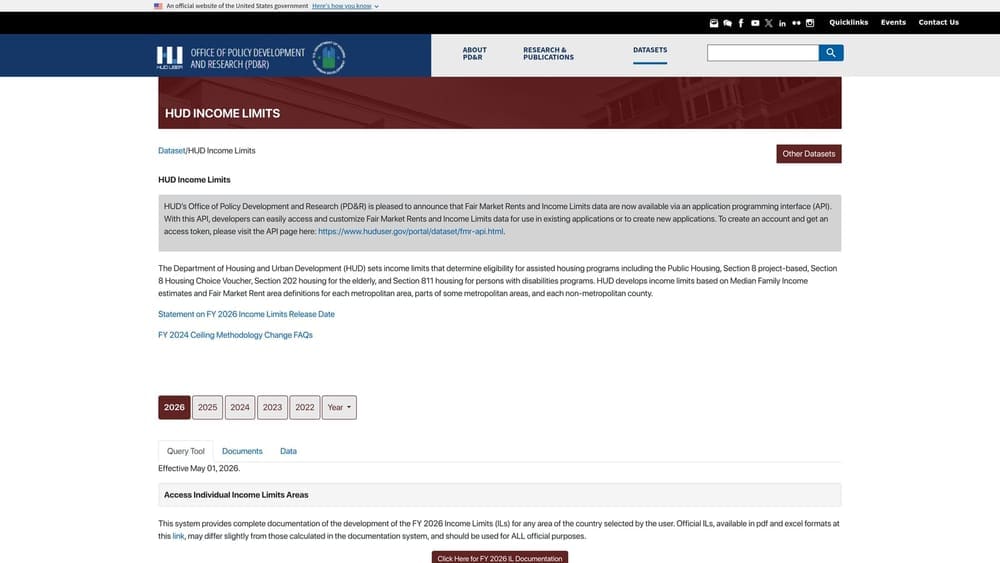
The HUD Area Median Income dataset is the authoritative source lenders and DPA programs use to determine income eligibility — updated annually and broken down by county and household size. Florida buyers should pull their specific county’s data before applying for any income-limited program.
Where This Tool Shines
Most buyers discover they are ineligible for a DPA program after they have already started the pre-approval process — often because they relied on a third-party summary of income limits rather than the current HUD dataset. The HUD AMI page eliminates that risk. It is the primary source, not a summary, and it is what lenders actually reference when verifying eligibility.
Florida’s no state income tax creates an interesting dynamic here: gross income in Florida is higher relative to take-home pay than in most states, which can push some buyers above AMI thresholds even when their net purchasing power feels comparable to buyers in taxed states. Understanding where your gross income falls relative to your county’s AMI — before applying — prevents surprises.
Key Features
County-by-County Data: AMI thresholds for every Florida county — not statewide averages that obscure local variation.
Annual Updates: Dataset is updated each year — always verify you are using the current year’s figures, not cached data from a third-party site.
Household Size Breakdowns: Limits are provided for 1 through 8 person households — critical for accurate eligibility assessment when family size affects the threshold.
Program Cross-Reference: Used by FL Assist, FL HLP, FHA, USDA, and other income-limited programs — one source that applies across multiple program eligibility checks.
Best For
Any buyer considering income-limited programs including FL Assist, FL HLP, FHA, or USDA financing. Particularly important for buyers in higher-cost Florida counties where AMI thresholds may be closer to their actual income than they expect.
Pricing
Free. Public government dataset — no account or registration required.
5. VA.gov — Home Loan Guaranty and COE Portal
Best for: Florida veterans and active-duty military verifying VA loan eligibility before pre-approval
The VA Home Loan Guaranty portal is the official U.S. Department of Veterans Affairs resource for verifying VA loan eligibility and obtaining a Certificate of Eligibility — a required document for any VA loan pre-approval. Florida veterans should start here before contacting any broker.
Where This Tool Shines
The Certificate of Eligibility is not optional for VA financing — it is the document that confirms your entitlement amount and funding fee status. Brokers can often pull a COE on your behalf, but knowing your entitlement status before the conversation begins puts you in a stronger position. It also confirms surviving spouse eligibility, which is an often-overlooked benefit.
VA loans represent one of the most powerful financing tools available in Florida. No PMI requirement, competitive rates, and eligibility down to 500 FICO with the right broker — a threshold well below what conventional financing requires. For Florida veterans who also qualify for Salute Our Soldiers, the combination of a VA first mortgage and state DPA can result in a purchase with very little out of pocket at closing.
Key Features
Certificate of Eligibility Request: The COE is required for VA loan pre-approval — this portal is the direct, official source.
Entitlement and Funding Fee Confirmation: Confirms your entitlement amount and whether you qualify for a funding fee exemption (available to veterans with service-connected disabilities).
Low FICO Threshold: VA loans are available down to 500 FICO with the right broker — no PMI required regardless of down payment amount.
Surviving Spouse Verification: Confirms eligibility for surviving spouses of veterans — a benefit that is frequently underutilized.
Program Cross-Reference: Links to VA-approved lenders and relevant state programs including Salute Our Soldiers for Florida buyers.
Best For
Active-duty military, veterans, and surviving spouses purchasing in Florida. Particularly valuable for buyers with lower credit scores who may not qualify for conventional financing but can access VA programs with the right broker.
Pricing
Free. No fee to obtain a COE through the official portal.
6. FEMA Map Service Center
Best for: Florida buyers who need to assess flood zone risk before finalizing a pre-approval amount
FEMA’s Map Service Center is the only authoritative source for flood zone designations — the same maps lenders and insurance carriers reference. In Florida, a flood zone designation can add hundreds of dollars per month to housing costs, directly affecting your DTI and the pre-approval amount you can qualify for.
Where This Tool Shines
Florida’s geography makes this tool non-optional. Coastal properties, properties near rivers, and even some inland properties sit in Special Flood Hazard Areas where federally required flood insurance is mandatory. That insurance cost becomes part of your monthly escrow payment — and it is included in the housing expense calculation that determines your DTI ratio.
A buyer who gets pre-approved for a $400,000 purchase without accounting for $200 to $400 per month in flood insurance may find their DTI disqualifying once the actual property is identified. Running an address check on FEMA’s tool before you finalize your target price range prevents this problem. It is one of the most Florida-specific steps in the pre-approval process that national mortgage content consistently ignores.
Key Features
Official FEMA FIRMs: Flood Insurance Rate Maps are what lenders and insurers reference — this is the primary source, not a third-party interpretation.
Property-Level Lookup: Search by specific address to determine flood zone designation for any target property in Florida.
Zone Identification: Identifies Zone A, AE, X, and other designations that determine whether flood insurance is mandatory or optional.
DTI Impact Awareness: Mandatory flood insurance in high-risk zones adds to monthly escrow — directly affecting how much home you can qualify for at any given pre-approval amount.
Best For
Every Florida buyer — but especially those targeting coastal, waterfront, or low-elevation properties. Should be run on any specific address before making an offer, and ideally before finalizing the purchase price range in your pre-approval planning.
Pricing
Free. No account required.
7. AnnualCreditReport.com
Best for: Reviewing all three bureau credit reports before initiating any pre-approval process
AnnualCreditReport.com is the only federally authorized source for free credit reports from all three major bureaus — Equifax, Experian, and TransUnion — mandated under the Fair Credit Reporting Act. Florida buyers should pull and review all three reports before initiating any pre-approval.
Where This Tool Shines
Errors on credit reports are more common than most buyers expect, and they can delay or reduce qualification. Reviewing your reports before a broker initiates any no hard inquiry mortgage pre approval process gives you the opportunity to identify and dispute errors while you still have time to resolve them — rather than discovering a problem mid-application when timelines are compressed.
This tool is also the correct source for a reason that matters: many commercial “free credit score” services provide only one bureau’s report, may charge subscription fees after a trial, and often use your data for marketing purposes. AnnualCreditReport.com is the FCRA-mandated source — no subscription, no upsell, no data monetization.
Key Features
All Three Bureaus: Equifax, Experian, and TransUnion reports are all accessible — the complete picture lenders see when evaluating your application.
Error Identification: Allows buyers to identify inaccuracies before the mortgage pre approval without hard pull process begins — time to dispute and correct before it affects qualification.
Weekly Access: Free weekly reports are currently available — verify the current policy at the time of use, as this was expanded from the prior annual access model.
Dispute Pathway: Review reports and dispute errors directly through each bureau’s process after identifying discrepancies.
Best For
Every buyer, regardless of credit confidence. Particularly important for buyers who have not reviewed their credit in the past year, those who have experienced identity theft or fraud, and buyers who are targeting programs with specific minimum FICO thresholds.
Pricing
Free. Federally mandated access — no subscription required.
8. IRS Get Transcript
Best for: Self-employed buyers and those with complex income who need to prepare documentation before pre-approval
IRS Get Transcript is the official tool for retrieving tax return transcripts online — documents lenders require during income verification for pre-approval. Having your transcripts ready before you apply speeds up the process significantly.
Where This Tool Shines
Lenders require IRS Form 4506-C verification as part of the income documentation process — they use it to confirm that the tax returns you provide match what was actually filed with the IRS. Pulling your own transcripts first lets you see exactly what a lender will see, which is particularly valuable if your income situation is complex: variable earnings, self-employment, multiple income streams, or years where income fluctuated significantly.
For self-employed Florida buyers pursuing bank statement loans or Non-QM financing, reviewing your transcripts in advance helps you and your broker determine which income documentation approach best represents your qualifying income — before the formal application begins.
Key Features
Instant Transcript Access: Tax Return Transcript and Wage and Income Transcript available immediately through the secure online portal.
Lender Alignment: Pulling your own transcript first reveals exactly what lenders will see during 4506-C verification — no surprises at underwriting.
Self-Employed Documentation: Critical for buyers using bank statement loans or documenting variable income — helps determine the best income presentation strategy before application.
Multi-Year Access: Available for current and prior tax years — most lenders require two years of documentation, and both are accessible through this tool.
Best For
Self-employed buyers, freelancers, business owners, and anyone with variable or complex income. Also useful for W-2 employees who want to accelerate the documentation phase of their pre-approval by arriving prepared.
Pricing
Free. Secure IRS government portal — no third-party service needed.
9. Florida Department of Revenue — Homestead Exemption Guidance
Best for: Florida buyers who want an accurate long-term ownership cost picture during pre-approval planning
The Florida Department of Revenue’s Homestead Exemption guidance page covers Florida Statute 196.031 — which provides a $50,000 reduction in assessed property value for primary residences. Understanding this benefit during pre-approval planning gives buyers a more accurate picture of long-term ownership costs.
Where This Tool Shines
Pre-approval calculations use the assessed property value as a basis for estimating property tax escrow. What many buyers do not realize is that the assessed value used in their pre-approval estimate may not reflect the Homestead Exemption — because the exemption is applied the year after purchase, filed by March 1 through the county property appraiser’s office. This means first-year property tax costs are typically higher than they will be in subsequent years.
Understanding this dynamic during the pre-approval phase — rather than after closing — helps buyers plan cash flow accurately. The Save Our Homes cap, which limits annual assessed value increases to 3% after the first year, compounds the long-term benefit and is documented on this same page.
Key Features
Florida Statute 196.031 Coverage: The $50,000 assessed value reduction for primary residence owners — the governing statute cited by exact number, not vague “Florida law” references.
Long-Term Cost Reduction: Reduces annual property tax bill, which lowers long-term housing cost below the initial pre-approval estimate — a genuine financial benefit worth quantifying.
Filing Timeline Clarity: Must be filed by March 1 of the year following purchase — the first year of ownership typically does not reflect the exemption in tax calculations.
Save Our Homes Cap: Annual assessed value increase is capped at 3% after the first year — additional long-term protection against rising property taxes in appreciating Florida markets.
Best For
All Florida primary residence buyers — but especially those purchasing in counties with higher property tax rates, where the $50,000 assessed value reduction under Florida Statute 196.031 produces a meaningful annual savings. Also valuable for buyers comparing the total cost of ownership across multiple target properties.
Pricing
Free. Official government resource — no account required.
DPA Breakeven: Should You Use FL Assist?
If you are considering FL Assist as part of your pre-approval strategy, the decision is not simply “free money versus no free money.” There is a 3-variable breakeven calculation that every buyer should run before committing to a DPA-layered loan.
Here is a worked example using conservative, illustrative figures. Actual rate premiums and program terms must be verified with current Florida Housing data at the time of application.
Scenario: Buyer uses FL Assist ($10,000 DPA, 0% deferred second mortgage) on a $300,000 loan. To access FL Assist, the first mortgage may carry a slightly higher rate than a non-DPA loan.
Rate premium assumption: 0.25% (conservative illustrative figure — verify current terms).
Monthly cost of that premium: Approximately $62 per month in additional interest on a $300,000 loan.
DPA received: $10,000 (applied toward down payment or closing costs).
Breakeven calculation: $10,000 divided by $62 per month equals approximately 161 months, or roughly 13.4 years.
Interpretation: If you stay in the home longer than approximately 13 years, the DPA net benefit is positive — you received $10,000 upfront and the rate premium cost has not yet exceeded that amount. If you sell or refinance before that point, the cumulative rate premium cost may exceed the DPA benefit.
This is the 3-variable breakeven: rate premium, DPA amount, and ownership timeline. Your specific numbers will differ based on current program terms and your loan amount. A Florida-licensed mortgage broker serving clients statewide can run this calculation against your actual scenario before you commit to a DPA-layered pre-approval path.
Frequently Asked Questions
What is the difference between mortgage pre-qualification and pre-approval?
Pre-qualification is an informal estimate based on self-reported income, assets, and debt — no documentation or credit verification required. Pre-approval is a verified, documented assessment that involves income documentation, asset verification, and a credit review. Pre-approval carries real weight with sellers and listing agents; pre-qualification generally does not in competitive Florida markets.
Does mortgage pre-approval hurt your credit score in Florida?
A traditional pre-approval involves a hard credit inquiry, which can temporarily affect your score. However, Florida Mortgage Maestro’s NoTouch Credit process uses a Vantage Score 4.0 soft pull for the initial eligibility assessment — delivering a genuine pre-approval review without a hard inquiry impacting your credit report. This is the soft credit pull mortgage approach that protects your score while you explore options.
How long does a mortgage pre-approval last in Florida?
Most pre-approval letters are valid for 60 to 90 days. If your home search extends beyond that window, your broker will typically refresh the documentation and reissue the letter. In fast-moving Florida markets, having your documents organized and ready to refresh quickly is a practical advantage.
Can I get pre-approved without a hard credit inquiry?
Yes. Florida Mortgage Maestro’s no-credit-hit mortgage application process uses a Vantage Score 4.0 soft pull for the initial assessment — mortgage pre-approval without hard pull impact on your credit. This allows buyers to understand their eligibility and explore program options before committing to a formal application that triggers a hard inquiry.
What documents do I need for mortgage pre-approval in Florida?
Most pre-approvals require two years of W-2s or tax returns, recent pay stubs (30 days), two to three months of bank statements, a government-issued ID, and documentation of any other income sources. Self-employed buyers typically need two years of tax returns plus a year-to-date profit and loss statement. Pulling your IRS transcripts in advance through IRS Get Transcript speeds up this process significantly.
Does Florida’s no state income tax help me qualify for a larger mortgage?
Yes, in a meaningful way. Florida has no state income tax, which means your gross income is more fully available for debt service than it would be for a buyer with the same salary in a state that taxes income. Lenders calculate DTI using gross income — and in Florida, more of that gross income translates to actual take-home pay, improving your real-world affordability relative to the DTI calculation. This is one of Florida’s genuine financial advantages for homebuyers.
How does flood insurance affect my mortgage pre-approval amount in Florida?
If a target property sits in a Special Flood Hazard Area (SFHA) as identified by FEMA’s Map Service Center at msc.fema.gov, flood insurance is federally required. That insurance premium becomes part of your monthly escrow payment, which is included in the housing expense calculation that determines your DTI ratio. A significant flood insurance cost can reduce the purchase price you qualify for at a given income level. Always check FEMA flood zone designation before finalizing your target price range.
Can I get pre-approved for a VA loan in Florida with a low credit score?
VA loans can be approved down to 500 FICO with the right broker — a threshold well below conventional financing requirements, and with no PMI required regardless of down payment. Florida veterans should obtain their Certificate of Eligibility through VA.gov before beginning the pre-approval process, and should work with a broker who has experience layering VA financing with Florida state programs like Salute Our Soldiers.
Which Tool Is Right for Your Situation
The nine tools in this list are not competing with each other — most buyers will use several of them in sequence. But if you are trying to prioritize, here is a quick guide by buyer type.
First-time buyer: Start with the CFPB calculator to understand your affordability range, then check HUD AMI data for your county to assess DPA eligibility, then use Florida Housing’s portal to understand FL Assist and FL HLP terms. Initiate the pre-approval process through Florida Mortgage Maestro’s NoTouch Credit process to protect your score while you explore options.
Veteran or active-duty military: Begin at VA.gov to obtain your COE and confirm entitlement. Review Florida Housing’s Salute Our Soldiers program. Then work with a broker who can layer VA financing with state DPA — and run the FEMA flood zone check on any property you are seriously considering.
Self-employed buyer: Pull your IRS transcripts first to understand what lenders will see during income verification. Review your credit reports at AnnualCreditReport.com. Then initiate a soft pull mortgage broker consultation to determine whether a bank statement loan or Non-QM product is the right fit before committing to a documentation approach.
Credit-rebuilding buyer: Start at AnnualCreditReport.com to identify and dispute any errors. Then pursue a no hard inquiry mortgage pre approval consultation to understand where you stand without further credit impact. Florida’s VA loan pathway (down to 500 FICO) may be available if you have military service history.
Duane Buziak, NMLS #1110647, is a Florida-licensed mortgage broker serving clients statewide through Coast2Coast Mortgage LLC, NMLS #376205. With access to hundreds of lenders and a NoTouch Credit process that protects your score from the first conversation, the goal is to match each buyer with the right program — not the most convenient one. Get your credit-safe consultation today and find out which loan options fit your specific situation, your income, and your timeline.