
Getting a mortgage as a self-employed borrower in Florida isn’t harder — it just requires a different paper trail. Where a W-2 employee hands over two pay stubs, you’re documenting income through tax returns, profit-and-loss statements, bank statements, and business financials. The good news: the right tools make this process far more manageable, and Florida’s no state income tax environment can actually work in your favor when lenders calculate your debt-to-income ratio.
This list covers the top tools — from broker platforms to IRS resources to income calculators — that directly address self-employed mortgage approval requirements. Each one serves a specific purpose in building a clean, lender-ready application. If you’re also exploring down payment assistance programs, first-time buyer resources, or specific loan programs for self-employed borrowers, those guides pair well with what you’ll find here.
Written by Duane Buziak, NMLS #1110647 | Coast2Coast Mortgage LLC, NMLS #376205 | Florida-licensed mortgage broker serving clients statewide.
1. Florida Mortgage Maestro
Best for: Self-employed Florida borrowers who need bank statement loans and a no-credit-impact eligibility check
Florida Mortgage Maestro is a Florida-licensed mortgage broker operation run by Duane Buziak, NMLS #1110647, serving self-employed clients statewide through Coast2Coast Mortgage LLC, NMLS #376205.
Where This Tool Shines
The biggest friction point for self-employed borrowers shopping lenders is the credit inquiry problem: every hard pull can ding your score, and multiple inquiries during rate shopping compound that damage. Florida Mortgage Maestro solves this with a NoTouch Credit process using Vantage Score 4.0, a soft credit pull that gives Duane everything needed to assess your eligibility without a hard inquiry hitting your report. That’s a meaningful distinction when you’re still figuring out which loan program fits your income structure.
The second advantage is reach. Rather than being locked into one bank’s product menu, this broker shops hundreds of lenders simultaneously — including non-QM and bank statement lenders that many traditional banks don’t access. For self-employed borrowers whose tax returns show aggressive write-offs, bank statement programs are often the more accurate reflection of actual cash flow. Florida’s no state income tax also means your take-home is higher relative to borrowers in states like California or New York, which can strengthen your DTI picture when presented correctly.
Key Features
NoTouch Credit (Vantage Score 4.0): Soft pull eligibility check with no impact to your credit score — a true no hard inquiry mortgage pre approval process.
Hundreds of Lenders: Simultaneous access to conventional, non-QM, bank statement, and government loan programs across Florida.
Bank Statement Programs: 12-month and 24-month bank statement options for self-employed income documentation when tax returns understate real income.
Cash-Out Refinance to 90%: Higher-than-standard cash-out ceiling for qualifying borrowers who need to access equity.
24/7 Availability and Fast Close Times: Responsive availability with a track record of faster-than-average close timelines — important in competitive Florida markets.
Best For
Self-employed Floridians with complex income structures: sole proprietors with heavy Schedule C write-offs, S-Corp owners drawing a salary plus distributions, freelancers with variable 1099 income, or any borrower who wants to explore bank statement loan options before committing to a conventional application. Also strong for veterans using Salute Our Soldiers DPA alongside a VA-eligible loan structure.
Pricing
No upfront fee for consultation. The no-credit-impact eligibility check is free. Broker compensation is disclosed transparently at the loan estimate stage, as required by federal law.
2. IRS Get Transcript Tool
Best for: Verifying your own tax records before a lender submits Form 4506-C to the IRS
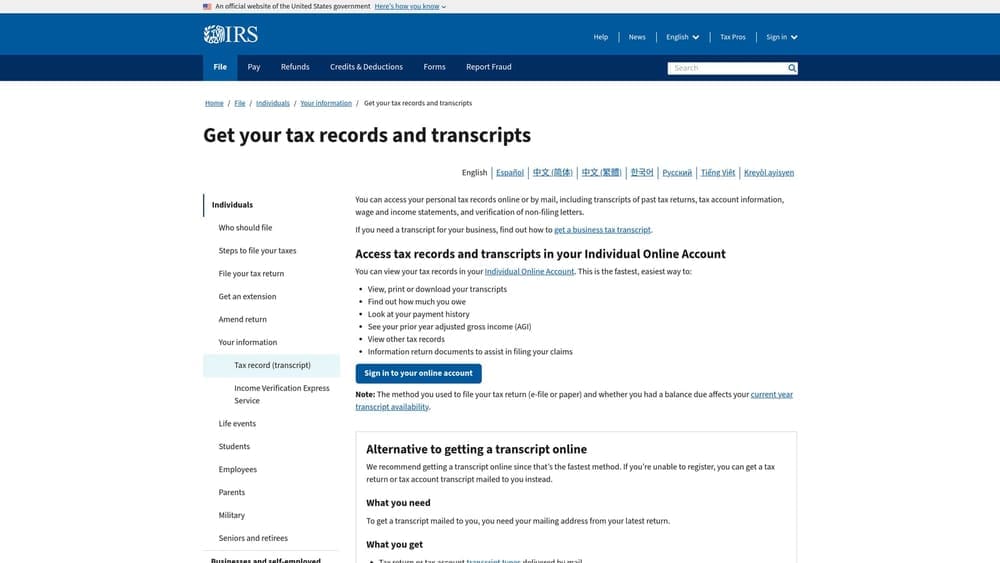
IRS Get Transcript is the official IRS tool for pulling your personal tax transcripts — the same records your lender will request during underwriting.
Where This Tool Shines
Here’s a scenario that stalls more self-employed mortgage applications than most borrowers expect: the tax returns you hand your broker don’t match what the IRS has on file. Maybe a return was amended, a filing was delayed, or a schedule was submitted separately. Lenders submit Form 4506-C directly to the IRS during underwriting, and any discrepancy between your documents and the IRS transcript can freeze the process.
Pulling your own transcript before you apply lets you catch those gaps first. You’ll see exactly what the IRS has processed — your 1040, all schedules including Schedule C and Schedule E, any K-1 income, and your account status. Identity verification is handled through ID.me, and access is instant once verified.
Key Features
Tax Return Transcripts: Full 1040 with all schedules — the exact document lenders request via 4506-C.
Wage and Income Transcripts: Covers 1099, Schedule C, and K-1 income reported to the IRS by third parties.
Account Transcripts: Shows whether your return has been processed, amended, or flagged — critical for timing your mortgage application.
ID.me Verification: Secure identity verification to protect access to sensitive tax records.
Instant Access: Online delivery for most transcript types — no waiting for mail.
Best For
Every self-employed borrower should use this before submitting a mortgage application. It’s especially important if you’ve filed amended returns, have multiple business entities, or experienced any IRS correspondence in the past two years. Think of it as a pre-flight checklist for your application.
Pricing
Free. Official IRS service with no cost to the borrower.
3. CFPB Mortgage Calculator
Best for: Stress-testing monthly payment scenarios and DTI thresholds without any lender sales pressure
The CFPB Mortgage Calculator is the Consumer Financial Protection Bureau’s dedicated payment modeling tool — no lead capture, no sales agenda, just clean math.
Where This Tool Shines
Self-employed borrowers often need to model multiple income scenarios before they know which qualifying income figure a lender will actually use. The CFPB calculator lets you input different loan amounts, rates, and terms and see the full PITI (principal, interest, taxes, and insurance) payment — the number that actually matters for DTI calculation.
Because Florida has no state income tax, your effective take-home is higher than a comparable earner in a taxed state, which can give you more DTI runway than you might assume. Running a few scenarios through this calculator before your consultation helps you walk in with realistic expectations. And because this is a government tool, there’s no algorithm nudging you toward a particular lender or product.
Key Features
Full PITI Modeling: Inputs for principal, interest, taxes, insurance, and HOA — the complete monthly housing expense figure.
Adjustable Inputs: Loan amount, interest rate, and loan term are all adjustable for scenario comparison.
DTI Stress-Testing: Useful for running “what if” scenarios across different qualifying income estimates.
No Account Required: No login, no data collection, no follow-up marketing.
Government-Neutral: No lender bias or product recommendations embedded in the results.
Best For
Self-employed borrowers in the early research phase who want to understand what purchase price is realistic given their estimated qualifying income. Also useful after receiving a Fannie Mae income worksheet result (Tool #5) to model what that qualifying income actually supports in terms of purchase price.
Pricing
Free. Official CFPB tool with no cost and no registration.
4. QuickBooks Self-Employed
Best for: Sole proprietors and freelancers who need CPA-shareable P&L statements for mortgage applications
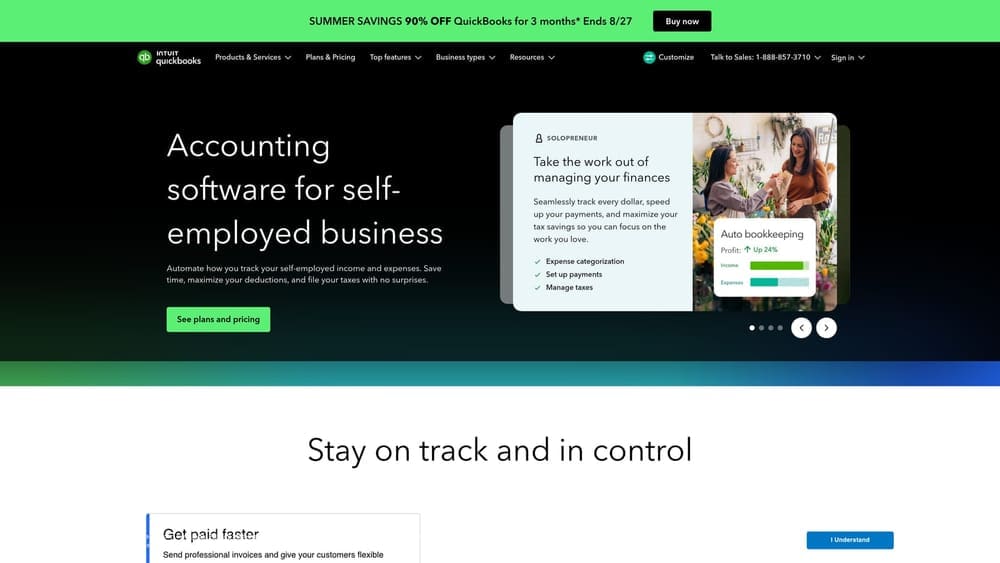
QuickBooks Self-Employed is Intuit’s bookkeeping platform designed for independent workers — and it generates the profit-and-loss documentation many lenders require from self-employed applicants.
Where This Tool Shines
Many lenders — particularly for conventional loans — require a year-to-date P&L statement alongside your tax returns. Some require CPA preparation or signature; others accept a well-organized self-prepared report. QuickBooks Self-Employed connects to your bank accounts and credit cards, automatically categorizes income and expenses, and generates P&L reports in formats that CPAs can review and certify quickly.
The Schedule C alignment is particularly useful: QuickBooks categories map directly to IRS Schedule C expense categories, which means your bookkeeping and your tax filing tell a consistent story. Lenders and underwriters notice when documentation is internally consistent — it reduces back-and-forth during underwriting. One important note: some lenders do require a CPA-prepared or CPA-reviewed P&L rather than a self-generated one. QuickBooks output is an excellent starting point for that CPA conversation, not necessarily a final document on its own.
Key Features
Automatic Categorization: Connected accounts sort income and expenses automatically, reducing manual bookkeeping time.
Exportable P&L Reports: Standard format profit and loss statements exportable for CPA review or lender submission.
Schedule C Alignment: Expense categories mirror IRS Schedule C — keeps your bookkeeping and tax filing consistent.
CPA-Shareable Access: Accountant access feature lets your CPA review and certify reports without you exporting and emailing files.
Tax Summary Reports: Year-end summaries that align with what your tax preparer needs — useful for keeping records clean year-round.
Best For
Sole proprietors, freelancers, and independent contractors who file Schedule C and need organized, lender-presentable income documentation. Less suited to S-Corp owners or partnership members who have more complex entity-level bookkeeping needs — those borrowers may need a full QuickBooks Online account or dedicated CPA support.
Pricing
Paid subscription. Check current pricing at quickbooks.intuit.com/self-employed/ — plans and promotional pricing change regularly.
5. Fannie Mae Self-Employment Income Calculator
Best for: Understanding exactly how an underwriter will calculate your qualifying income from Schedule C, E, or K-1
Fannie Mae’s self-employment income resources include the official income analysis worksheet that mirrors the Schedule Analysis Method conventional loan underwriters actually use.
Where This Tool Shines
Here’s the core problem for self-employed borrowers: your gross revenue isn’t your qualifying income. Your tax return qualifying income isn’t your gross revenue either. After depreciation addbacks, business mileage, depletion, and other adjustments, the number a conventional lender uses can look very different from what you’d expect. Fannie Mae publishes the exact formula — the Schedule Analysis Method — and this worksheet walks through it line by line.
Running your own numbers through this tool before your application tells you two things: first, whether a conventional loan is realistic given your documented income; second, whether a bank statement program (which uses deposit averages rather than tax return income) might qualify you for a higher loan amount. Florida’s no state income tax means your actual cash flow is stronger than a comparable borrower in a high-tax state — but that advantage only shows up in a bank statement analysis, not in a conventional tax-return-based calculation. Knowing both numbers before you apply gives you real leverage in choosing the right loan structure.
Key Features
Schedule C Analysis: Sole proprietor income calculation including all standard addbacks and deductions.
Schedule E and K-1 Coverage: S-Corp, partnership, and rental income analysis using Fannie Mae’s methodology.
Depreciation and Addback Handling: Correctly accounts for non-cash deductions that are added back to qualifying income.
Net Qualifying Income Output: Shows the actual number underwriters will use — not gross revenue, not taxable income, but qualifying income.
Free and Official: Published by Fannie Mae for use by lenders and borrowers — no third-party interpretation required.
Best For
Self-employed borrowers pursuing conventional financing who want to understand their qualifying income before a lender runs the numbers. Also valuable for borrowers on the conventional/non-QM borderline who need to decide whether to pursue a tax-return-based or bank-statement-based application strategy.
Pricing
Free. Published directly by Fannie Mae as part of their originating and underwriting resource library.
6. FEMA Flood Map Service Center
Best for: Florida property buyers who need to check flood zone designation before locking a purchase price
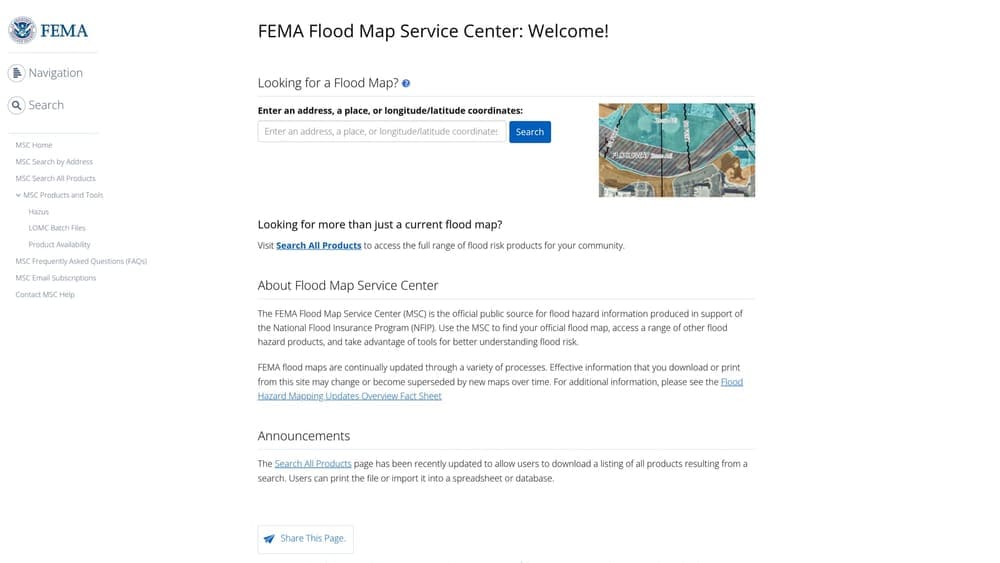
FEMA’s Flood Map Service Center is the official address-level lookup tool for flood zone designation — and in Florida, this check belongs early in your home search, not at closing.
Where This Tool Shines
Florida has a disproportionately high share of FEMA-designated Special Flood Hazard Areas compared to most states, particularly in coastal markets, South Florida, and riverine areas. If a property falls in Zone A or AE, lenders require mandatory flood insurance — and that premium becomes part of your PITI calculation. For self-employed borrowers already navigating a complex income documentation process, an unexpected flood insurance requirement can push DTI over a lender’s threshold and change what you qualify for entirely.
The fix is simple: check the flood zone before you make an offer. FEMA’s tool gives you the designation by address, shows you the underlying Flood Insurance Rate Map (FIRM), and links to National Flood Insurance Program resources so you can estimate the premium impact before it appears on a loan estimate. This is also relevant under Florida Statute 196.031 planning: the Homestead Exemption provides a $50,000 assessed value reduction on your primary residence for property tax purposes, but flood insurance costs are a separate, ongoing expense that doesn’t benefit from that exemption.
Key Features
Address-Level Flood Zone Lookup: Property-specific designation — not just neighborhood-level approximations.
Zone Identification: Clearly identifies Special Flood Hazard Areas (Zone A, AE) where mandatory flood insurance applies.
FIRM Downloads: Access to the underlying Flood Insurance Rate Maps for detailed review.
NFIP Resources: Links to the National Flood Insurance Program for premium estimation and policy information.
Free and Official: Direct FEMA source — no third-party interpretation or data lag.
Best For
Every Florida buyer, full stop — but especially self-employed borrowers with DTI calculations that are already close to lender thresholds. Knowing flood insurance costs before you lock a purchase price lets you factor them into your qualification modeling rather than discovering them at loan estimate.
Pricing
Free. Official FEMA government service.
7. HUD AMI Lookup Tool
Best for: Self-employed borrowers checking DPA program income eligibility by Florida county
HUD’s Area Median Income dataset is the official source Florida Housing uses to set income limits for FL Assist, FL HLP, and other down payment assistance programs.
Where This Tool Shines
Self-employed borrowers frequently assume their gross revenue disqualifies them from down payment assistance programs. That assumption is often wrong — and this tool is how you find out. Florida Housing DPA programs use HUD AMI thresholds by county, and qualifying income for DPA eligibility is sometimes calculated differently from mortgage qualifying income. Your tax return income (after write-offs) may actually land you within program limits even if your gross deposits look higher.
The dataset is updated annually and covers every Florida county with household-size-specific thresholds. Because Florida has no state income tax, your net income position is often stronger than borrowers in taxed states — which matters when you’re determining whether a DPA program makes financial sense relative to your actual take-home. Check your specific county’s AMI limits here before concluding you don’t qualify.
Key Features
County-Specific AMI Data: All Florida counties covered with precise income thresholds, not statewide averages.
Household Size Breakdown: Separate limits for 1 through 8-person households — relevant for self-employed borrowers with dependents.
Annual Updates: Reflects current HUD calculations, not outdated figures.
DPA Eligibility Baseline: The direct source Florida Housing uses to set program income limits — no interpretation layer between you and the actual criteria.
Free and Official: HUD government dataset, no cost, no account required.
Best For
Self-employed borrowers in any Florida county who want to verify DPA program eligibility before assuming they earn too much to qualify. Pairs directly with the Florida Housing Finance Corporation portal (Tool #9) for a complete DPA eligibility picture.
Pricing
Free. Official HUD dataset with no cost to access.
8. Wave Accounting
Best for: Self-employed borrowers building a clean 12–24 month income record for bank statement loan programs
Wave Accounting is free bookkeeping software that organizes bank transactions into the categorized deposit history that bank statement lenders require from self-employed borrowers.
Where This Tool Shines
Bank statement loan programs work by averaging your monthly deposits over 12 or 24 months to calculate qualifying income. The cleaner and more consistently categorized your deposit history, the easier that calculation is for the lender — and the fewer questions you’ll face during underwriting. Wave connects to your bank accounts and credit cards, automatically categorizes transactions, and generates monthly and annual income summaries you can export as reports.
Wave is a bookkeeping tool, not a mortgage tool — that distinction matters. It won’t tell you what loan you qualify for, and it’s not a substitute for CPA-prepared financials if your lender requires them. What it does is help you maintain the organized, consistent income record that makes a bank statement application straightforward rather than chaotic. For self-employed borrowers in Florida who benefit from no state income tax (meaning more of your gross deposits represent real spendable income), presenting that deposit history cleanly is worth the organizational investment.
Key Features
Free Bank Account Connection: Connects to business and personal accounts to pull transaction history automatically.
Automatic Categorization: Sorts deposits and expenses by type — useful for separating business income from transfers and non-income deposits.
Monthly Income Summaries: Exportable reports showing month-by-month deposit totals — the format bank statement lenders analyze.
Invoicing and Receipt Scanning: Included in the free tier — supports a complete income documentation picture.
Annual Reports: Year-over-year income summaries useful for demonstrating income stability across the 24-month window many lenders prefer.
Best For
Freelancers, contractors, and small business owners pursuing bank statement loan programs who need to present 12–24 months of organized deposit history. Also useful as a starting point for borrowers who will eventually need CPA-reviewed financials — organized books make the CPA’s work faster and less expensive.
Pricing
Free for core accounting features. Paid add-ons available for payroll processing and payment acceptance — not required for mortgage documentation purposes.
9. Florida Housing Finance Corporation Portal
Best for: Self-employed Florida borrowers verifying DPA program terms, income limits, and participating broker eligibility
Florida Housing Finance Corporation’s portal is the official state source for all Florida Housing loan and down payment assistance programs — including FL Assist, FL HLP, and Salute Our Soldiers.
Where This Tool Shines
Program terms for Florida’s DPA offerings change, and third-party summaries often lag behind. The Florida Housing portal is the authoritative, current source — which matters when you’re making financial decisions based on program specifics. For self-employed borrowers, the income limit verification is particularly important: because your qualifying income may differ from your gross revenue, you may be eligible for programs you’d assumed were out of reach.
The portal also maintains a participating lender directory — useful for verifying that the broker you’re working with is eligible to originate Florida Housing program loans. Not every broker participates, and this is worth confirming before you build your application around a specific DPA program. Florida’s no state income tax environment means your effective income position is stronger than it might appear on paper in a high-tax comparison, which is worth discussing with a participating broker when modeling DPA eligibility.
Key Features
FL Assist Program: Up to $10,000, 0% interest, fully deferred — no monthly payment, due on sale, refinance, or payoff. (Verify current terms at floridahousing.org before application.)
FL HLP Program: Up to $10,000, 3% interest, 15-year amortizing loan — carries a monthly payment of approximately $69. (Verify current terms at floridahousing.org.)
Salute Our Soldiers: Veteran-specific down payment assistance program with its own eligibility criteria.
County-by-County Income and Purchase Price Limits: Searchable by county — essential for self-employed borrowers with variable income.
Participating Lender Directory: Verify broker eligibility before committing to a program-dependent application strategy.
Best For
Self-employed first-time buyers and veterans exploring DPA programs alongside their mortgage application. Use this portal in combination with the HUD AMI tool (Tool #7) for a complete eligibility picture — the AMI data tells you the income threshold; the Florida Housing portal tells you the specific program terms and limits.
Pricing
Free resource. Program assistance terms are embedded in the loan structure — no separate cost to access the portal or program information.
Self-Employed Mortgage Documentation: Loan Type Comparison
Not every loan program evaluates self-employed income the same way. Here’s how the major options stack up for Florida borrowers.
Conventional (Fannie/Freddie) | Tax returns (2 years, all schedules) + YTD P&L | 2 years self-employed | 620+ (680+ preferred) | Borrowers with strong tax return income after write-offs
Bank Statement (Non-QM) | 12 or 24 months personal or business bank statements | 1–2 years (lender-specific) | 620–680+ (lender-specific) | Borrowers whose tax returns understate real cash flow
FHA | Tax returns (2 years) + YTD P&L | 2 years self-employed | 580+ (3.5% down); 500–579 (10% down) | Borrowers with lower credit scores or limited conventional options
VA (veterans) | Tax returns (2 years) + YTD P&L | 2 years self-employed (generally) | No VA minimum; lenders typically 580–620+ | Eligible veterans — no down payment required
USDA (rural FL) | Tax returns (2 years) + YTD P&L | 2 years self-employed | 640+ (most lenders) | Rural Florida buyers within USDA geographic and income limits
Note: Credit score minimums reflect general lender guidelines and vary by lender and loan scenario. A soft credit pull mortgage consultation is the most accurate way to assess your specific situation without impacting your score.
Frequently Asked Questions
Can I get a mortgage in Florida if I’m self-employed with two years of tax returns?
Yes. Two years of personal federal tax returns (with all schedules) is the standard documentation baseline for conventional, FHA, VA, and USDA loans. The key variable is what your qualifying income looks like after the lender applies their income analysis method — which is why reviewing your numbers through the Fannie Mae income calculator before applying is useful.
What income documents do self-employed borrowers need for a Florida mortgage?
Standard requirements include: two years of personal tax returns with all schedules, two years of business tax returns (if applicable — S-Corp, partnership, or C-Corp), a year-to-date profit and loss statement, 12–24 months of bank statements (especially for non-QM programs), and a business license or CPA letter confirming at least two years in business. Specific requirements vary by loan program and lender.
Do Florida lenders use gross or net income for self-employed mortgage approval?
Neither, exactly. Lenders use qualifying income — a calculated figure derived from your tax returns using a method like Fannie Mae’s Schedule Analysis Method. Qualifying income typically starts with net profit, then adds back certain non-cash deductions (depreciation, depletion, business mileage) and subtracts certain expenses. It’s often lower than gross revenue and higher than taxable income. The Fannie Mae income calculator (Tool #5) shows this calculation explicitly.
Can I qualify for a Florida mortgage using bank statements instead of tax returns?
Yes, through bank statement loan programs (also called non-QM loans). These programs average your monthly deposits over 12 or 24 months to calculate qualifying income, bypassing the tax return analysis entirely. They’re particularly useful for borrowers whose tax returns show aggressive write-offs that reduce qualifying income below what’s needed for conventional approval. Florida Mortgage Maestro offers access to these programs through its lender network.
How does Florida’s no state income tax affect my mortgage DTI as a self-employed borrower?
Florida has no state income tax, which means your net take-home income is higher than a comparable earner in a state with income tax. For DTI purposes, lenders look at gross qualifying income versus monthly debt obligations — and because you’re not losing income to state taxes, your actual disposable income is stronger. This doesn’t directly change how lenders calculate qualifying income from your tax returns, but it does mean your real financial position is often better than borrowers in high-tax states facing the same gross income figure.
What credit score do I need for a self-employed mortgage in Florida?
It depends on the loan program. Conventional loans typically require 620 minimum (with 680+ preferred for the best pricing). FHA loans allow 580 with 3.5% down. VA loans have no official minimum but most lenders require 580–620+. Bank statement and non-QM loans vary by lender, generally 620–680+. The most accurate way to assess your credit position without impacting your score is through a soft pull mortgage broker consultation.
Can self-employed borrowers qualify for FL Assist or FL HLP down payment assistance?
Yes, subject to income and purchase price limits set by Florida Housing Finance Corporation. Qualifying income for DPA eligibility may be calculated differently from mortgage qualifying income — which means borrowers who assume their gross revenue disqualifies them should verify against their county’s HUD AMI threshold before concluding they’re ineligible. Check current limits at floridahousing.org and the HUD AMI dataset at huduser.gov.
Does checking my mortgage eligibility hurt my credit score?
Not with Florida Mortgage Maestro. The NoTouch Credit process uses Vantage Score 4.0 — a soft pull that gives Duane what he needs to assess your eligibility and loan options without triggering a hard inquiry. This mortgage pre approval without hard pull approach is particularly valuable for self-employed borrowers who may be comparing multiple options before committing to an application.
Choosing the Right Tools for Your Situation
If you’re a self-employed borrower in Florida, the tools on this list aren’t meant to be used all at once — they’re meant to be used in sequence, matching the stage of your application.
Start with the IRS Get Transcript tool and the Fannie Mae income calculator to understand what your documented income actually looks like to a lender. Then run that qualifying income figure through the CFPB mortgage calculator to see what purchase price it supports. Check the FEMA Flood Map Service Center early in your property search, before you’re emotionally attached to a specific home — flood insurance costs can materially affect your DTI. And if you’re considering down payment assistance, use the HUD AMI tool and the Florida Housing portal together to verify eligibility before building your application around a specific program.
On the DPA question: here’s a worked example worth thinking through. If you use FL Assist ($10,000 DPA, 0% deferred) but your rate is 0.25% higher than the market rate on a $350,000 loan, that rate premium costs approximately $875 per year in additional interest. Your breakeven is roughly $10,000 ÷ $875 = 11.4 years. If you plan to stay fewer than 11 years, the DPA is net-positive. If you plan to stay longer, the rate premium gradually erodes the benefit. These are illustrative numbers for the formula — your actual rate premium and timeline will differ, and a broker consultation is the right place to run your specific scenario.
Also worth noting under Florida Statute 196.031: the Homestead Exemption provides a $50,000 assessed value reduction on your primary residence, which lowers your annual property tax bill. This benefit doesn’t apply in the first year if you purchase after January 1 — the first full exemption appears on the following year’s tax bill. Factor this into your long-term cost-of-ownership calculation.
For most self-employed Florida borrowers, the right starting point is a no-credit-impact consultation that maps your specific income documentation to the loan programs you actually qualify for. Get your credit-safe consultation today and find out which loan structure fits your income, your timeline, and your Florida homeownership goals.
One Response